
i received this comic as a patreon donor to the wiggle bird mailing club. you can purchase the comic without becoming a member directly from the artist’s itchio page. please forgive my sloppy photo work for the images as i no longer have access to a working scanner. bummer!

“can you find alissa may?” (CYFAM, from here on out) is the first book i’ve received from the wiggle bird mailing club, which i subscribed to in a fit of envious passion approximately one month ago. as my own comic work becomes increasingly refined and over-rendered to the point where i fear it is in the process of becoming “plastic” (that is: artificial, lifeless, and inauthentic), i’ve been looking with barely concealed jealously over at artists whose passions whirl over the pages they produce with a confidence and a ferocity that leaves me in a sort of dazzled haze after exposure. “i want what they have” i mumble to myself as i pace around my room. “i want rawness. i want experimentation. i want ambiguity”, these are things i chant as i become mired in self-pity lol. i must live vicariously through these artists whose comics are unpretentious; who are able to (seemingly) effortlessly produce the kind of presentation that would make me look like a poser and/or a hack were i to try to dip my own hands into these pools. i mention this not just to navel-gazing about myself: i just need to express the immense, cathartic relief felt once i pulled this out of the envelope and got a look at the cover. perhaps it would be more accurate to describe what i’m feeling as “hunger”. i am hungry for something more, even if that “more” comes in bite-sized packages once a month. it beats having to shovel down empty calories over and over again.
i have a handful of small notes that are outside of discussing the plot and themes i want to make a point to bring up:
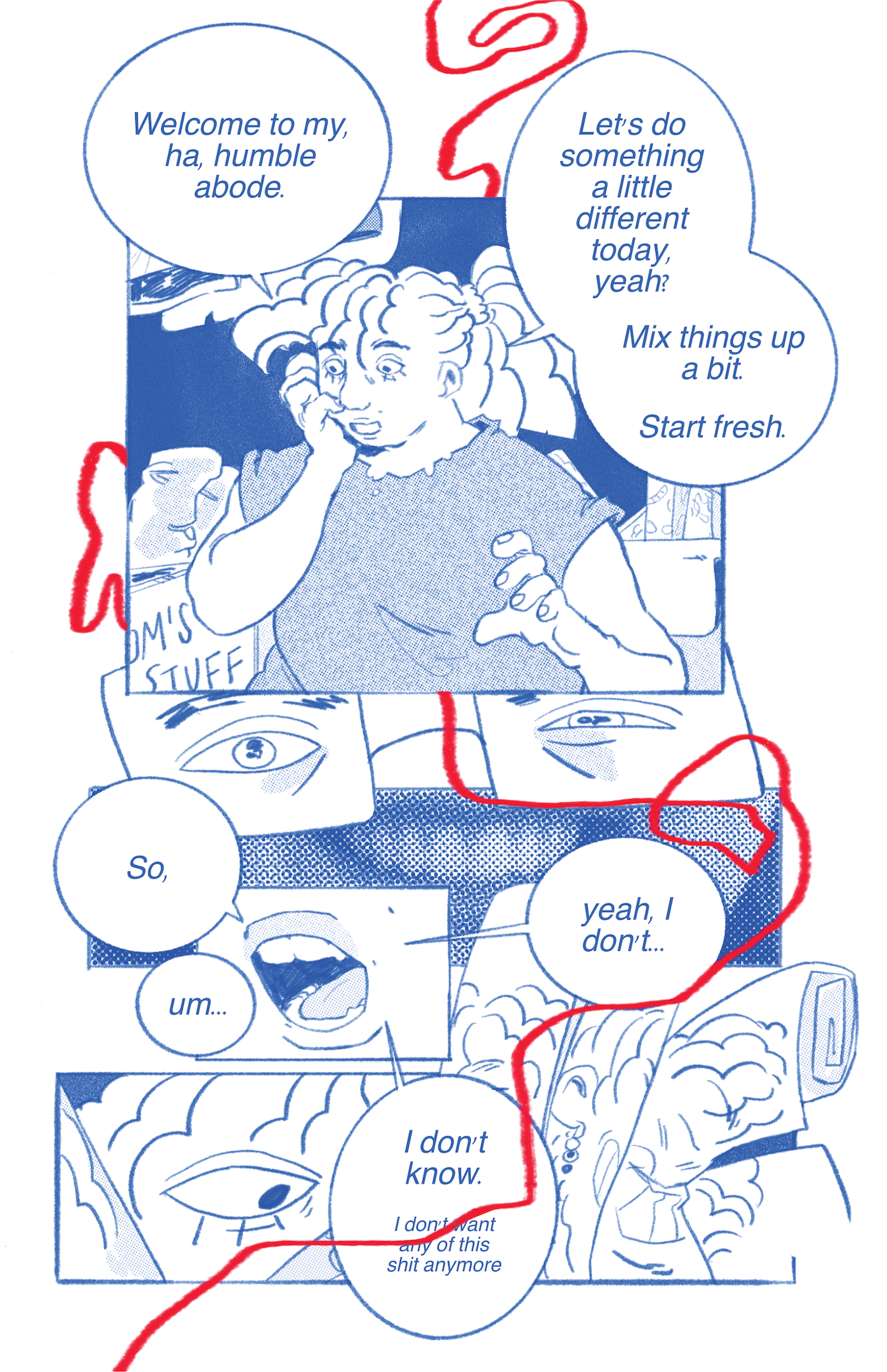
- use of color: the comic (with the exception of the cover, which is cyan-blue ink on white paper) is monochrome black ink on that pale, ice-blue printer paper i once associated with classrooms and flyers. in a comic that revolves around online activity, the paper and ink color choice emulates the disquieting blue light of a computer screen. the digital version appears to use a white background with blue and red (!) line work, so if this paper version is an attempt to evoke the digital experience in a paper format, its an inventive way to so do. however, looking at the preview images on itchio, i can’t help but feel a little something was lost by removing the red. the little scarlet strand of frustration and unbalanced thought in one page is palpable and splits the page more overtly. regardless, i’ll be reviewing what i have in my hand, which was very satisfactory to me. its interesting to see how this comic was translated into a paper format, the concessions that were made, and what was forfeit or altered in the translation.
- font: rather than using a “comic” font, the work leans heavily on the impersonal nature of a stark sans-serif. the font variation (where there is any) seems to loosely delineate a difference between performance, artificiality, and disquieting authenticity through the lens of one social media user’s experience.
CYFAM’s cover and title are styled to resemble a question posed by a google CAPTCHA, the ubiquitous means of human authentication we are all begrudgingly forced to interact with if we want to do anything online at all. two of the nine CAPTCHA panels are a photo of a human face, the remaining seven are scrambled blocks filled with contextless chunks of cartoon faces; disjointed and ill-fitting (especially when put up against the sparse, recognizably human elements that barely resemble the illustrations), they instill a sense of uneasy caricature. the gap between the “real” and the “image” is evidently a gulf. this tableau bamboozled at least one reviewer who assumed that the mishmash of faces and question posed meant that the story was a mystery intended to be solved, but the comic’s central conflict (underneath the layers of paranoia and perceived betrayal) is a question of how to determine authenticity and what we (the audience) impress onto the people we know only through the slivers they choose to present through a screen.
the narrative of CYFAM is uncomplicated: alissa may is a modern day video startlet who appears to have made her career on “lifestyle vlogging” and who has attracted the unsettling attention of the unnamed protagonist. the protagonist perceives a change in alissa’s behavior and presentation as caused by something external, concluding that a malevolent something has substituted itself for the “real” alissa. though readers will perceive alissa’s changes as the result of a humiliating public breakdown, the protagonist’s inability to intuit intent and how suffering manifests in troubled people has lead them to draw severely damaging conclusions regarding their relationship with alissa (surface level, cordial, distant) and reveals that their ability to comprehend reality from their own shallow, internal fiction is broken.
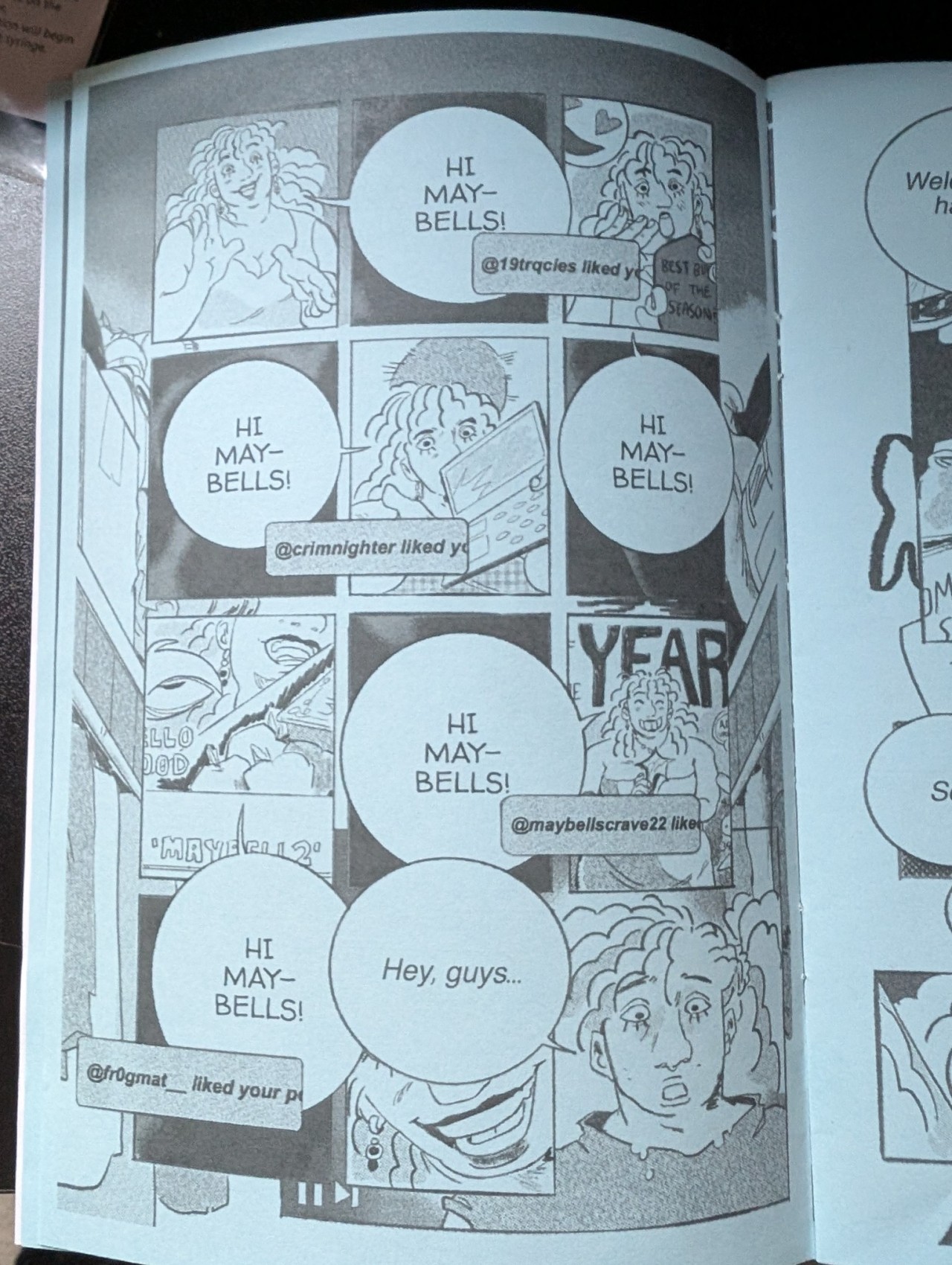
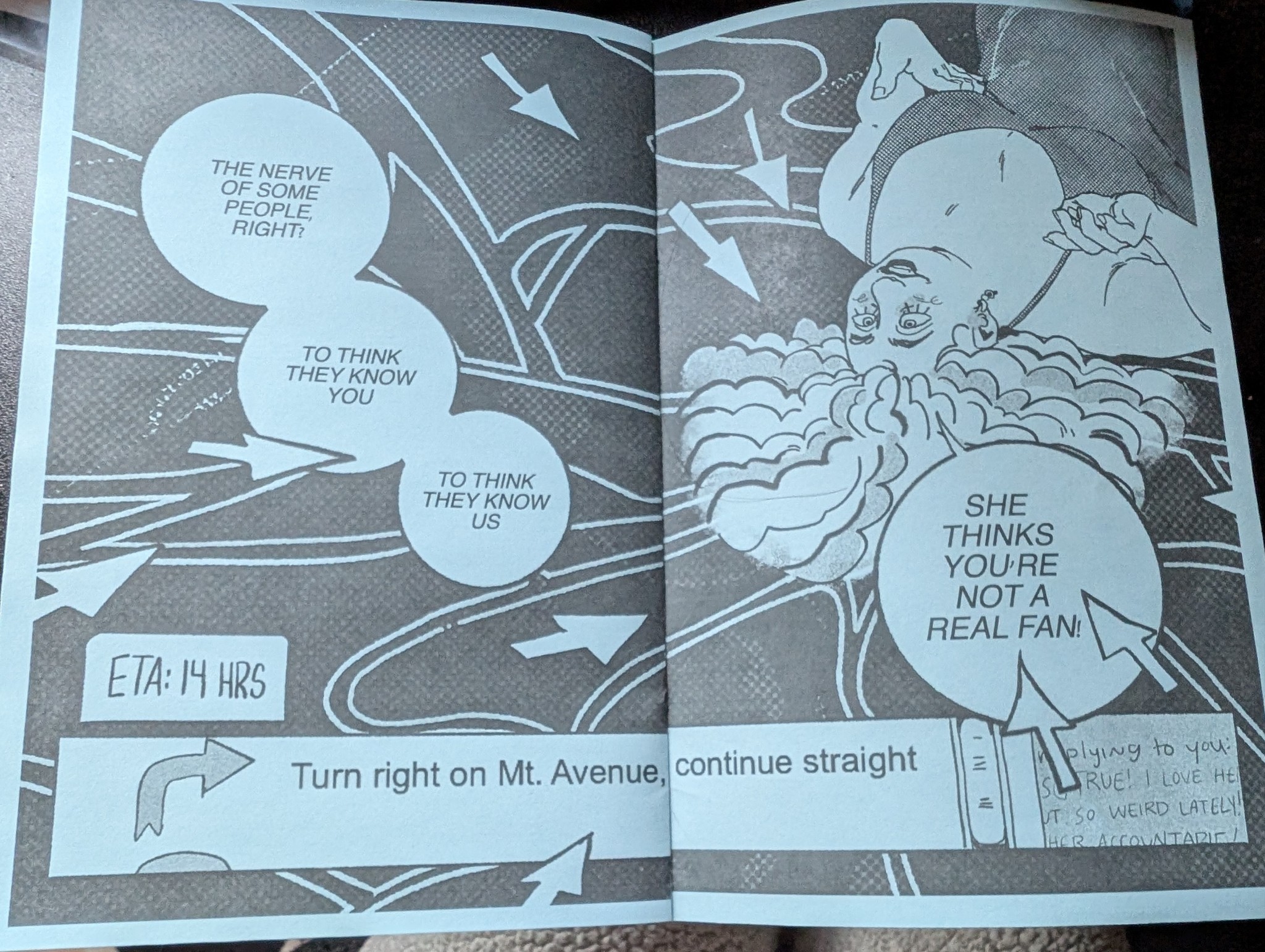
a montage of old videos shows alissa waving directly to her “may-bells”, shilling products and sponsors, acting as the instructor in make-up tutorials, and winning an industry award for her work. this alissa is carefully cultivated for the camera; in contrast to her later appearances that sparks the “identity crisis” in the protagonist, she makes a point of presenting in accordance to what women are “expected” to act and look like: make-up, low-cut camisoles and dresses, and long, flowing hair. in a later page, the sensual memory of alissa in the protagonist’s mind fans her hair out onto the “floor” where it melds into a map of roads and streets, drawing the protagonist toward her in what is presumed to be a sinister end. the alissa of the mind beckons the protagonist toward her, but the real alissa is (apparently) more complex and paradoxical.
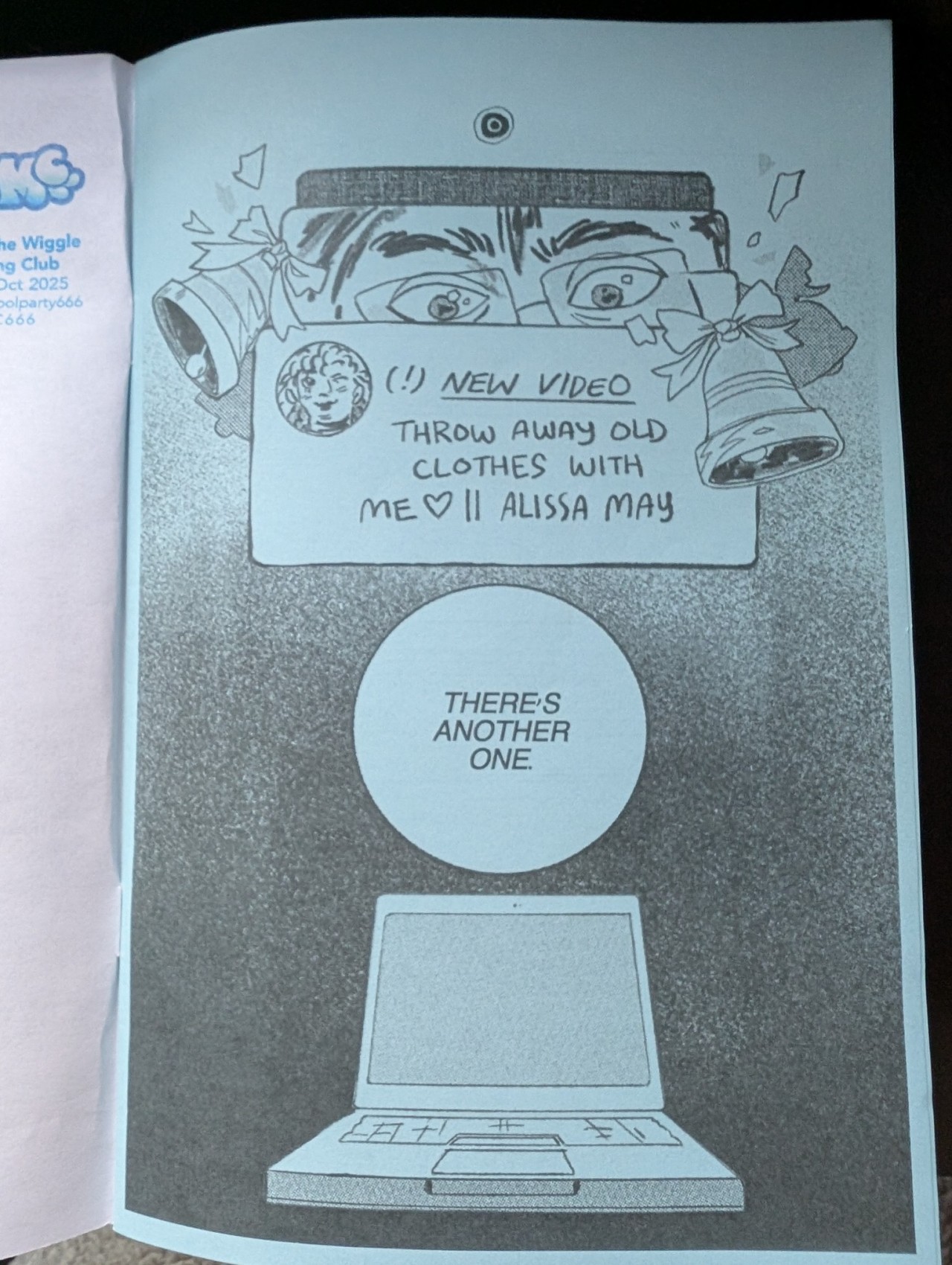
the nameless protagonist is an obsessive fan of alissa may’s, whose level of devotion to her is made immediately apparent by the wedding bells that frame the push notification of a new video. alissa’s smiling face winks through her static avatar even as it begins to deviate from the appearance of the woman on screen. there is a widening dichotomy between the alissa who embraces her vlogging fandom, and the alissa who appears as a “perverted copy”. the “new” alissa wears frayed, hole-ridden shirts while live-streaming herself throwing away clothes and gifts, getting in physical fights in public, and drunkenly spurning her audience. alissa’s rejection and humiliation of the protagonist plays out quietly in the margins of her videos and the protagonist’s delusional “conversations” with their idea of what alissa should be and how she should act. the wedding bells return, but the message they herald is a humiliating dismissal of the protagonist’s (admittedly completely detached from reality) concern. when the wedding bells return for the final time, its when the protagonist becomes resolute in their decision to confront alissa in person while she’s shattering to pieces in public.
i find the protagonist to be the least compelling part of the story; their motivations are comprehensible even if they are rooted in a version of reality exclusive only to them. “parasocial relationships” are a frequent topic of discussion when it comes to once “ordinary” people rocketed to semi-stardom through their charisma, talents, and/or marketing prowess and the topic has been exhaustively examined (or at least it feels like it has) from every possible angle by people working in nearly every medium and genre. my interest was piqued by the mystery presented through the character of alissa: what is she going through right now?
we are never given a direct explanation for alissa’s drastic change in appearance or behavior. like the protagonist, readers are left with only what is presented to the camera and must (although, “must” we? do we really have to, as audience members, do this?) weave a narrative out of the bits and pieces that leak through the screen. at most, we see a box labeled “mom’s stuff” in the background of a video where she throws her possessions away on camera, insinuating (possibly, but really, who knows?) that her mother passed away.
at the risk of selfish introspection, i empathize a lot with how alissa apparently expresses her pain. while its not uncommon for people to push away those who love them in times of crisis, i would guess that the public, systematic destruction of your own work and livelihood is a significant step beyond what most people experience. it is not just that alissa is rude to her audience or unappreciative of them, its that she can no longer see the value (if there ever was any) in what she produces and appears to be in the process of permanently destroying any value, financial and personal, it once held to her.
and yet, when she seems close to severing the bond for good, she pulls back. though she could simply turn the camera off, she returns again and again, begging her audience not to forget her, drinking just to get through streams. she rapidly oscillates between open displays of sorrow and rage, seemingly aware of how damaging this behavior is but unable to curb or prevent it. what is alissa feeling? is it fear, spurred by a reminder of mortality and a personal loss? did it make her wonder what her own legacy will be? if she made her mother proud with her work? if she was creating work that bettered the world? is it mental illness? is she just tired of keeping up a facade for the camera as her choice of career? some combination of these elements. i know that part of what keeps me coming back is the history i have with what i’ve created. what was the point? was it all for nothing? for ego? did it serve a purpose to anyone but me? can we really just throw it, and the people who loved us, away so casually after everything? it feels monstrous to consider.
i don’t know. i don’t know alissa may. i only know myself and that’s the framework i have access to in order to “read” her character. in this way, the unnamed protagonist and i are unfortunately the same: we have our own narratives we impress upon her due to the one sided nature of our relationship as either a viewer or a reader. alissa may remains an enigma, but rather than trying to “solve” her narrative, perhaps its her right to remain unknowable to everyone, especially those who want to try to graft their own personal histories onto her inelegantly and without regard for her god-given right to be complicated and indecipherable.